
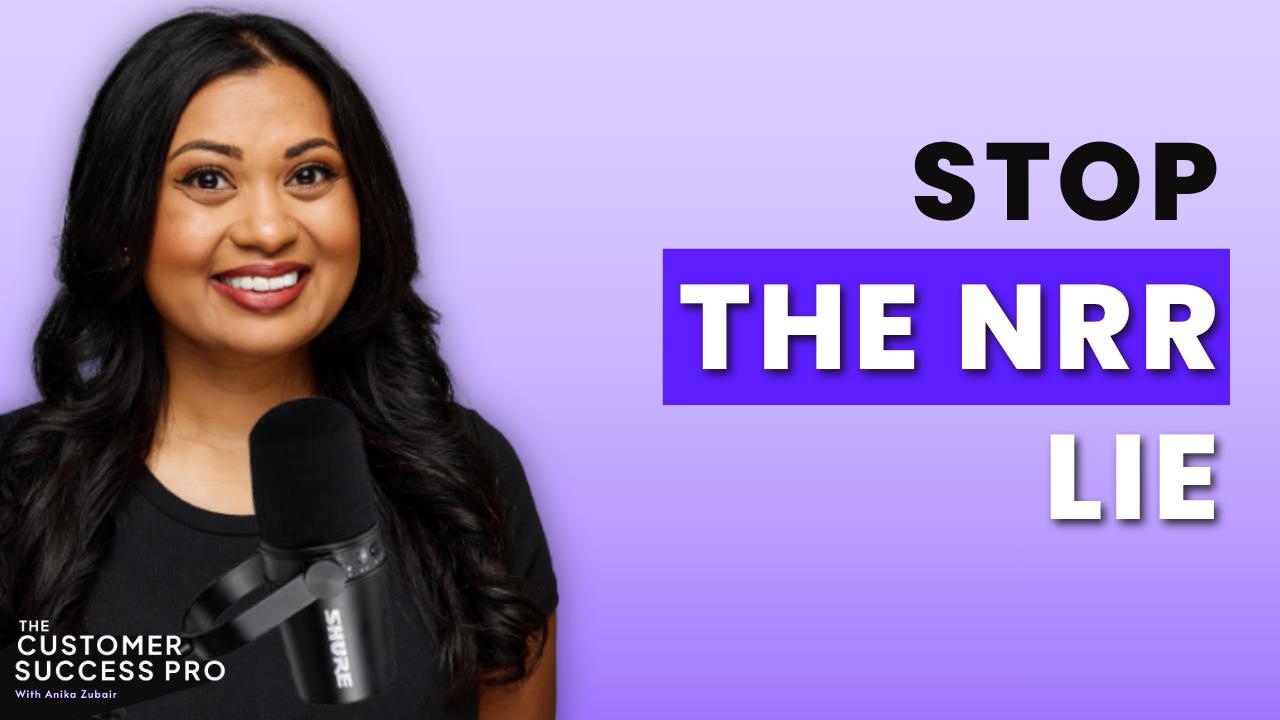
Why Your Team Missed NRR (And Why It Is Not a Talent Problem)
Sep 16, 2026Your customer success team did not miss net revenue retention (NRR) because they were lazy, not smart enough or lacking drive. They missed it because nobody ever built them a system where hitting the number was possible.
In this solo episode of The Customer Success Pro Podcast, Anika Zubair unpacks why missed NRR is almost always a design problem rather than a talent problem. After 16 years in B2B SaaS, she has watched that misdiagnosis cost people their careers.
NRR is the number your board, investors and CFO look at first, so it is worth understanding why teams keep missing it.
Why Missing NRR Is a Design Problem, Not a Talent Problem
A McKinsey analysis of more than 100 B2B SaaS companies found that the top quartile traded at a median of 24 times revenue, while the bottom quartile traded at about 5 times. The single biggest driver of that gap was net revenue retention.
SaaS Capital surveyed over 1,000 private software companies and found median NRR of 103% and median gross revenue retention of 91%. Meanwhile, ChartMogul data shows AI native SaaS companies sitting at a median NRR of just 48%.
So when leadership sets a 120% NRR target, they are asking for top quartile results. Yet many resource CS like the bottom quartile, with no commercial training or pricing authority.
When the number is missed, leaders usually call for performance reviews or a training day. Both treat it as a talent issue.
What usually happened is simpler. The CSM learned about the renewal 6 to 12 weeks out, the champion left months before anyone noticed, and procurement set the budget without the CSM in the room. That is a broken system, not a broken person.
The 4 Mistakes Behind Missed NRR Targets
1. Treating NRR as an outcome instead of a build. Most teams talk about NRR like the weather, something that happens to them. In reality, it is the sum of hundreds of commercial decisions made (or missed) over 12 months. By the time it appears on a board slide, you are not managing a number, you are reading a receipt.
2. Giving a team a number without levers to pull. Can your CSMs discount, package or defend a 12% uplift in front of a CFO? If not, you did not give them an NRR target, you gave them an NRR wish.
3. Building renewal processes backwards. Most renewal plays start when a task fires close to the renewal date. By then, the customer already knows whether they got value and the budget conversation has already happened. You are not negotiating at that point, you are receiving a verdict.
4. Confusing activity with coverage. A packed calendar of friendly check-ins with 1 happy contact is not coverage. Most CSMs cannot name every buying influence on their largest account, because nobody told them that was their job.
Closing the Skills and Systems Gap
Customer success grew out of support, account management and onboarding. CS professionals were hired for empathy, not for running commercial conversations or holding firm in a procurement negotiation. When CS became responsible for retention and expansion, companies handed a commercial job to a team trained for a service job, then called the gap a performance issue.
The fix is a team that can consistently do 4 things:
- Walk into a renewal with business outcomes already confirmed in the customer’s own numbers
- Handle pricing objections live, without escalating or discounting on the spot
- Name every stakeholder in a renewal and what each needs to believe to say yes
- Forecast their book with enough confidence that leadership trusts the number
These are learnable skills, not personality traits.
Anika shares a story from earlier in her career. She put a struggling CSM on a performance plan after a major retention miss, then looked closer. The CSM had 42 accounts, no expansion target, no discounting authority, a renewal alert firing 65 days out and a churned account whose new CFO had started 8 months before anyone knew. No one in that seat could have changed the outcome.
Think of a slow leak in a house. You can keep repainting the stained ceiling, but the water is coming from a cracked pipe 2 floors up. Your CS team is the ceiling, the place the damage shows up.
Key Takeaways
- Missed NRR is almost never a talent problem, it is a design problem wearing a person’s name badge
- Median private SaaS NRR sits around 103%, so 120% targets demand top quartile systems, training and authority
- NRR is built account by account over 12 months, long before it reaches a board slide
- Commercial skills (objection handling, stakeholder mapping, value storytelling and forecasting) can be taught
Try Anika’s 3 question test on your largest renewal in the next 2 quarters. First, name every person who touches the decision and what each needs to believe. Second, if the customer said “we are cutting vendor spend by 20%,” what is your exact next sentence? Third, what business result has this customer achieved in the last 12 months, in their numbers, that they would repeat to their CFO?
Leaders, run these questions live in your next team meeting. The answers will reveal more retention risk than your last 3 quarters of dashboards.
🎧 Listen on your favorite platform:
🔹 YouTube
🔹 Spotify
Author