The New Rules of Customer Success With AI: Why the Old Playbook is Broken
Aug 19, 2026AI tools are multiplying, adoption models are changing, and the playbook most CS teams were trained on is starting to creak. So what replaces it?
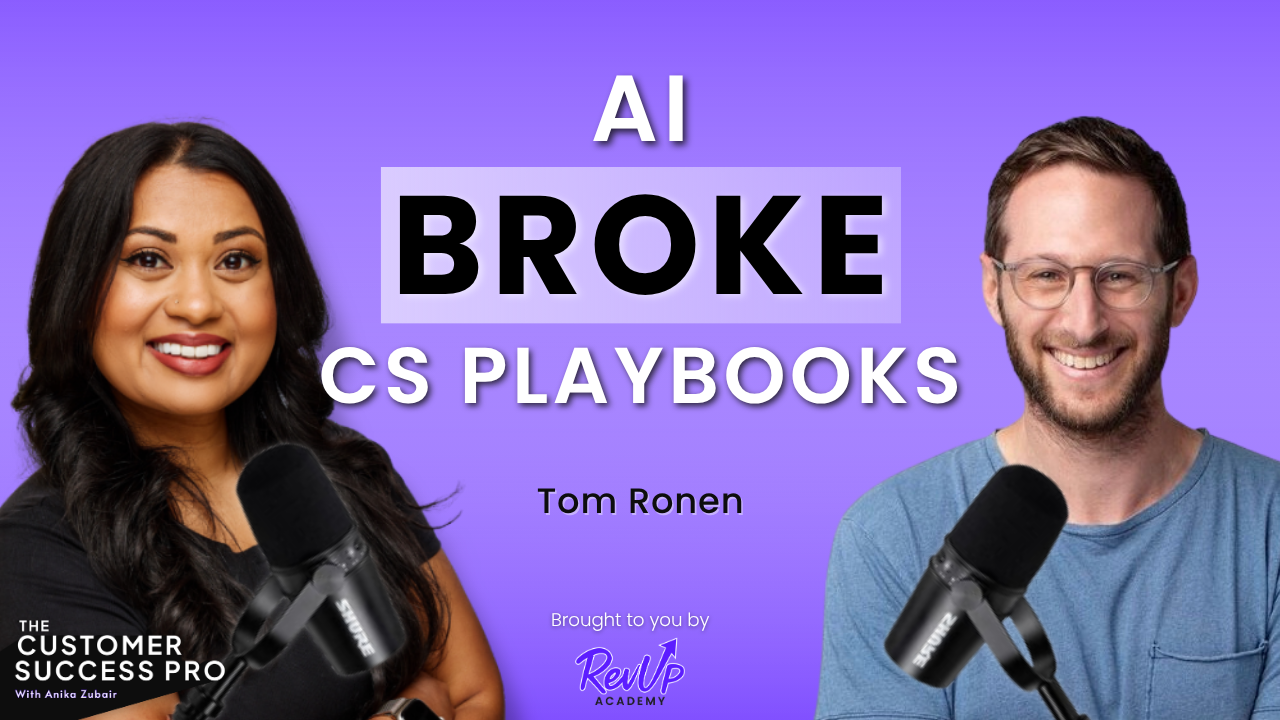
In this episode of The Customer Success Pro Podcast, Anika Zubair sits down with Tom Ronen, VP of Customer Success at Harvey, the AI platform working with some of the largest law firms and in-house legal teams in the world. Tom joined ten months ago after nine years at Monday.com, so he has lived both sides: the product led, data rich world and the high touch, human led one. His team owns GRR, expansion, and adoption. His argument, first made at SaaStr, is that AI is genuinely changing how people work, and the human element matters more than ever because of it.
Why the Old Customer Success Playbook Breaks in AI First Companies
The classic motion is familiar: gather requirements at kickoff, run a few implementation meetings and trainings, meet again at the QBR, push utilization, and treat utilization as the route to renewal.
Tom is clear the playbook is not bad, just mismatched to a certain kind of change. It works when you move a customer from Salesforce to HubSpot, or Asana to Monday. The destination changes, the way people work does not. It breaks when your product fundamentally changes how the work gets done.
Consider Harvey's customers. A lawyer may have practised the same way for twenty years. The filing cabinet became cloud storage, but the steps stayed intact. AI challenges all of that, which is an enormous change management project sitting on top of a software purchase.
The uncomfortable conclusion for founders and finance leaders is that this takes more post-sales investment, not less. Smaller books. Real enablement on change management. Enough agency for a CSM to fly out and spend three days with one customer. If AI is at the core of what you sell, Tom's view is that the super lean post-sales org will not hold, and the payoff arrives as outsized value once the change lands.
Discovery Is Change Management, Not a Sales Motion
Discovery is the skill CS has let slide, usually because admin work swallowed the calendar. Most teams do it at kickoff and never go deeper.
Tom reverse engineers it instead. If change management is the core competency, ask what a successful change requires and collect exactly that. Who holds influence. Who are your champions. Who is worried about what this technology means for their role. Which objectives the business actually cares about.
The framing matters. This discovery is not so you can upsell someone, it is because you cannot drive effective change without it. That earns a different quality of answer, and it needs trust behind it, because a customer only admits the hardest truth to someone they trust. Often that truth is that a powerful AI tool landed on their desk and nobody agreed what to do with it.
You also do not learn who holds influence over email. You learn it over lunch. So discovery never really ends, and everything gets captured: CRM notes, a Slack channel per customer, a product leader's conversation logged where the go to market team can use it. Account knowledge becomes organisational, not one CSM's private context.
Raise the Bar: Utilization, Value Stories, and Renewal Rigour
Utilization still matters, but the bar has moved. Harvey sees over 50% DAU over MAU, engagement closer to a consumer app than a typical B2B tool, with customers opening it about as often as Google Maps. When engagement with a core AI product runs that deep by default, anything less signals a problem. That means recalibrating health scores and resetting what green means.
Beyond usage sits the harder work. Harvey diligently collects value stories, the statements customers give in ordinary calls, from the right people and tied to the right business objectives. For law firms, using AI is becoming as unremarkable as using email, so nobody asks for its ROI. They ask the so what. Due diligence is faster, leverage is accruing, now what do we do with it? Answering that is where a vendor becomes a partner.
Renewals get a deliberately traditional mechanism. Every renewal above a certain size is reviewed six months out, sales and CS leadership together, poking holes beyond the usage stats. Do we have sponsorship? Are the value stories logged? What if the champion leaves tomorrow? AI crawls Slack and the CRM to keep it current, and the review itself teaches new joiners what a strong forecast looks like.
Key Takeaways
The old playbook is not wrong, it is mismatched to the depth of change AI demands. If AI is core to your product, invest more in post-sales, not less. Treat discovery as the input to change rather than a route to an upsell, and keep doing it long after kickoff. Capture context centrally so account knowledge belongs to the company. Raise your utilization bar and answer the so what your customers are already asking. Balance that human depth with a real data layer, because high touch alone does not scale. AI buys the leverage. The trust, the discovery, and the change still belong to humans.
🎧 Listen on your favorite platform:
🔹 YouTube
🔹 Spotify
Author