Scaling Digital Customer Success With AI: What Works and Where Humans Still Matter
Sep 09, 2026Digital customer success used to mean borrowing marketing tools and stitching together Zapier workflows to serve a long tail of small accounts. Now AI can draft an entire automation from a single prompt, and the possibilities are wider, along with the confusion.
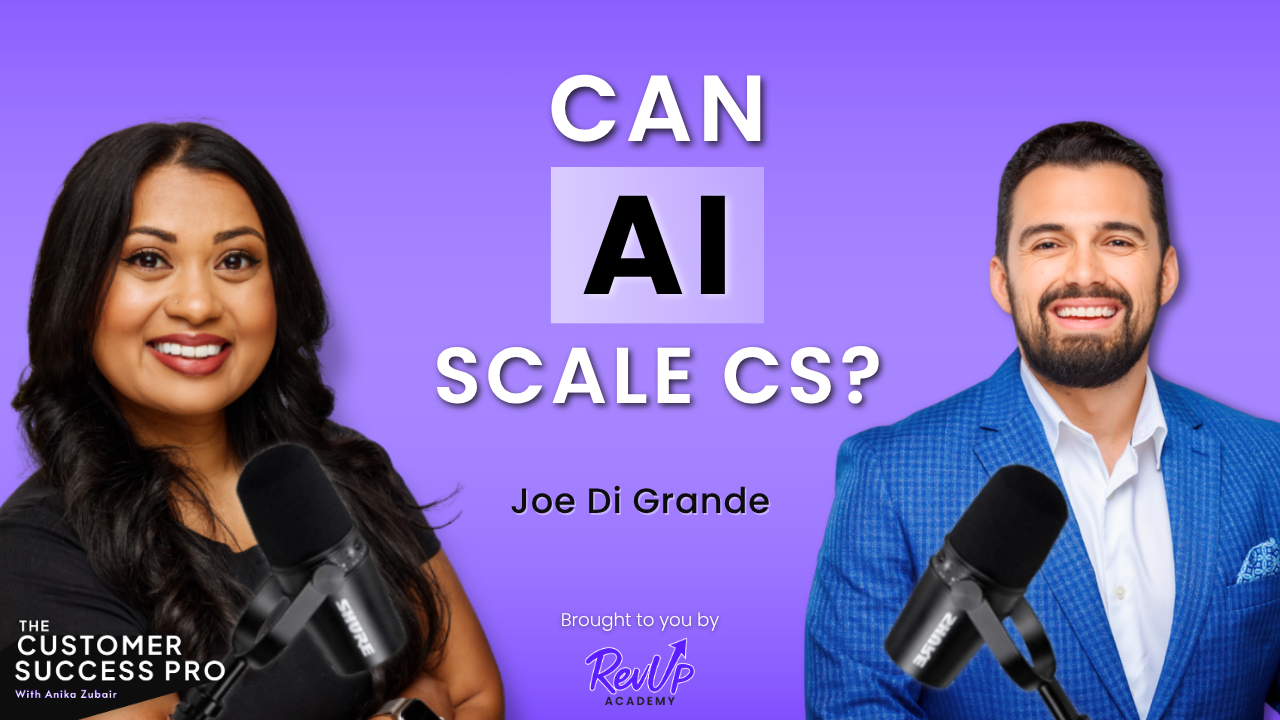
On this episode of The Customer Success Pro Podcast, host Anika Zubair sits down with Joe DeGrande, Director of Digital Customer Success at Gong, the revenue platform that recently crossed 500 million dollars in ARR. Joe has spent roughly ten years in digital CS, hosts the Customer Unsuccess Podcast, and writes the Joe Does Tech Touch newsletter. His team was recently renamed digital revenue architecture, a signal of where scaled CS is heading.
What Digital, Scaled, and Tech Touch Customer Success Actually Mean
The terms flying around CS are overwhelming, so Joe offers a simple map. Digital covers any use of technology to manage the post-sales motion, and can also describe a segment of digital first or self-service first customers. Pooled means a round robin of helpers, and scaled means someone loosely dedicated who leans primarily on technology. Tech touch, the original term, describes one-to-many motions where the human is removed from routine touchpoints but a human intervention strategy still exists underneath.
AI sits on top of all of this as the next generation of automation. Where rule-based tools relied on if-then branches, AI can take a plain language prompt and produce a working mock-up of a workflow. Joe's framing is that AI is a collaborator, not a replacement. It works with you, not against you, if you let it brainstorm, create structure, and get projects moving.
The catch is that speed does not replace judgement. Anika and Joe land on the calculator analogy: you still need to know that two plus two equals four to spot when the output is wrong. A leader who understands the customer journey can build in days what once took months. A leader who does not will get a confident, well-formatted mistake much faster.
Why Data and Customer Journey Come Before Any AI Build
Asked where he would start if a company with a solid high-touch model was told to build digital, Joe begins with the problem, not AI. Which stage of the journey, onboarding, adoption, or renewal, would have the biggest impact if addressed first? Pick one and work backwards. He also believes in building a proper digital segment where the customer base allows it, because sending automated communications to a 500K ARR customer and missing the mark is a fast way to lose trust.
Then comes data, and Joe treats content as data too, since models need something to train on. Point Claude Code at a workflow before checking whether usage, contract, and stakeholder data exists, and you build a beautiful agent with nothing to base decisions on.
Anika pushes on the reality that almost no company has clean data. Joe's answer is that messy data sends you back to rule-based automation. Scope the workflow, hand-pick a list of contacts in a tool like Gong Engage, run the flow, and prove the business case. Only then do you argue for cleaning data properly so the motion can scale. It is crawl, walk, run, and you are not going to boil the ocean.
Both agree AI has one useful side effect here: it exposes gaps in your data faster. Joe illustrates the risk with a story about asking a free AI tool about building a shed in New Jersey and getting Indiana building code. AI works on probability, so without context it guesses. Prompt it to show its work and to say when it does not know.
Where Humans Still Belong and How to Measure Digital CS
Joe expects much of what CS handled five to ten years ago to be handled by AI within four to five years. In tech touch that looks like autonomous flows running in the background, surfacing only when intervention is needed. Up market it looks like a CSM being prompted with a specific action, with high-stakes conversations staying human. He is watching the rise of virtual agents you cannot distinguish from a person, and the transparency question that raises for customers paying hundreds of thousands a year. An agent is unlikely to handle a customer arguing they are under-adopting when usage data says otherwise. Those soft skills belong to people, and as Anika puts it, humans trust humans.
On measurement, Joe is direct even if it earns him some flack. Deflection comes first, because the premise of digital is efficiency and scale. Can customers solve problems and see value on their own? Next is adoption, measured against your baseline before the motion went live, which raises an uncomfortable question about whether human conversations changed outcomes or simply went to whoever spoke loudest. Finally, revenue still matters. Whether your metric is GRR or NDR, the lagging indicator is whether the customer stays and grows.
Key Takeaways
AI is the next layer of automation and a collaborator, not a replacement for CS judgement. Start with the problem and the customer journey, not the tool. Data comes before any AI build, and messy data means running small rule-based experiments first. Prompt AI to show its work so it exposes gaps rather than hiding them. Keep a human intervention strategy, particularly up market where trust and negotiation are on the line. And measure digital CS on deflection, then adoption, then revenue.
🎧 Listen on your favorite platform:
Author