How to Forecast Renewals Accurately: Lessons From Customer Success Leaders
Oct 07, 2026For too long, renewal forecasting in customer success has run on gut feel. If your board is asking for a number and you are still counting green, yellow and red accounts, you are not alone, but it is time to move on.
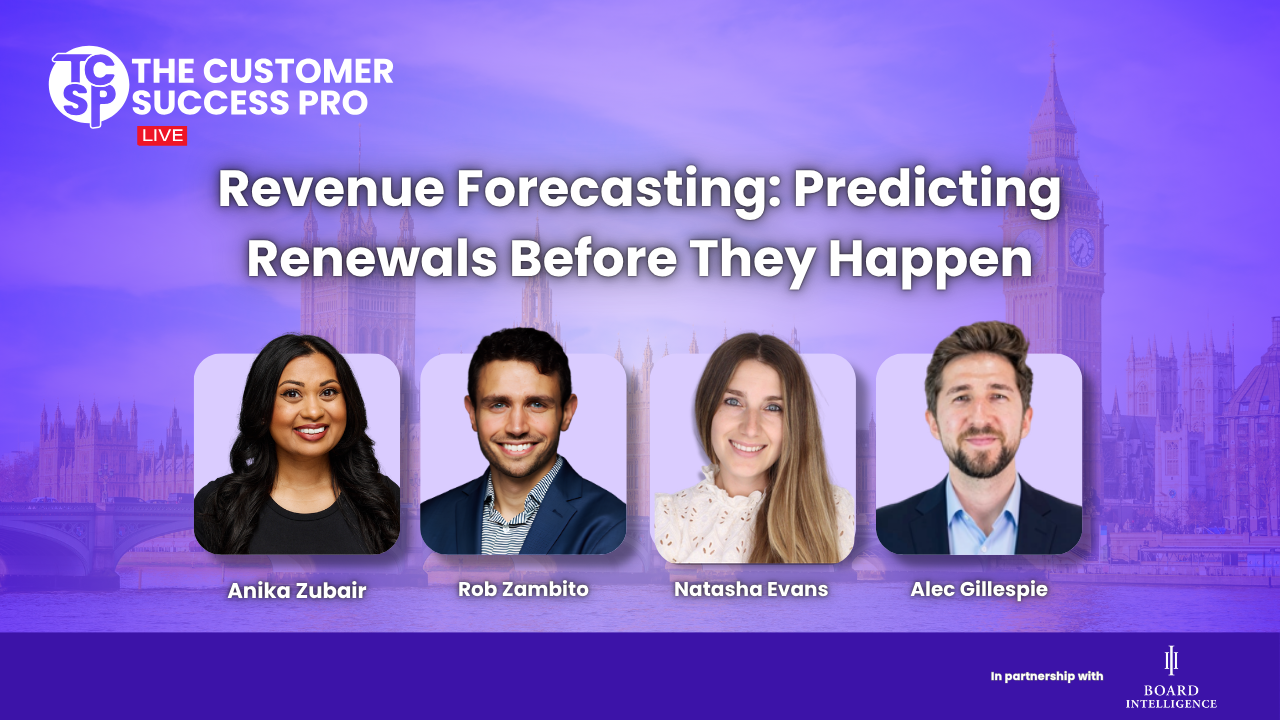
At a live recording of The Customer Success Pro Podcast, host Anika Zubair brought together 3 leaders to talk about predicting renewals before they happen. Natasha (Tash) leads the customer functions and marketing at Hook, an AI platform for CS teams. Alec Gillespie is Global Director of Customer Success at Board Intelligence, and Rob Zambito is founder and CEO of Success Scaled, a consultancy that has helped around 50 companies build and scale their CS teams.
Where Your Renewal Forecast Lives (and How Accurate It Really Is)
Rob's clients mostly run HubSpot dashboards where each renewal deal carries a probability weighting against its revenue. Alec's team runs on Salesforce plus a spreadsheet, and with AI doing the heavy lifting, his Friday update now takes about 20 minutes.
Tash runs a hybrid. Her CSMs enter forecasts account by account in HubSpot, but the board level roll-up lives in a spreadsheet so she can track how each week's call changes across the quarter. That history shows her who sandbags early and who is overly optimistic about saving risky accounts.
Accuracy is where it gets interesting. Alec's team now lands within about 4% of their forecast from a month before the quarter starts, though forecasting further out is still a work in progress. Tash's gross revenue retention (GRR) forecast is close to spot on, while forecasting expansion is harder. In early stage startups, Rob sees a swing of 4 to 6% between the start and end of a quarter, enough to turn an 88% GRR into a 92% one, or an 84%.
Why a Health Score Is Not a Renewal Forecast
Rob made the point that runs through the whole conversation: a healthy customer is not inherently more likely to renew. A competitor can launch a discount or a new CFO can start asking questions while every health signal stays green. This is the classic watermelon customer, green on the outside and red on the inside.
Alec builds in external factors that health scores miss. Mergers and acquisitions are his leading churn reason, yet getting in early has led to saves and even upsells into the acquiring company. Losing a key stakeholder is another, which is why multi-threading matters so much.
Tash was clear that not all health scores are bad. Predictive scores built on real user behaviour should inform your forecast, but they need extra layers. Her team tracks whether the customer has confirmed a value story, whether they have access to the economic buyer (EB), whether they have a true champion rather than a coach, and whether they have directly asked about the renewal. Hook is also experimenting with LLMs that listen to calls and turn those answers into data points.
Rob added a warning about stale scores. He once met a well established company whose health score was half usage and half NPS, untouched for 3 to 5 years. The best teams set a hypothesis each quarter about what predicts retention, then measure against it.
Run Renewals Like a Sales Pipeline
Alec asks his CSMs to treat every renewal as a deal, whether the cycle is 12, 24 or 36 months. Instead of starting the conversation 3 to 4 months out as a box to tick, they ask discovery questions early and often. As Anika put it, you may not work in sales, but if you own renewals, expansion or churn, you work in a revenue function.
Rob's best performing teams run 3 separate pipeline meetings for onboarding, renewals and upsells. Tash converts every forecast percentage into a churn dollar figure, because finding a specific amount across a book of business is far easier than finding 2%. Alec adds a churn buffer by segment, based on how much surprise churn historically appears in quarter. Anika recommends a good, better and best forecast so leaders always know the baseline and the stretch.
The panel also shared their favourite renewal questions:
- Ask customers to rate you, knowing they usually rate 1 grade higher than they really feel
- Try an anti-sell question, such as "why are you still here?", to surface what truly keeps them
- Ask whether they are getting the value they originally bought the product for
- Ask what the renewal process looks like inside their business, including who signs off and when budgets are set
Key Takeaways
- A health score and a renewal forecast are not the same thing, so layer in value, EB access, champions and direct renewal conversations
- Track external factors such as M&A activity, stakeholder changes, competitor activity and budget pressure
- Turn forecast percentages into dollar figures and build in a buffer for surprise churn
- Run dedicated pipeline meetings and treat every renewal as a sales deal from day 1
- Check your accuracy at the end of every quarter and update your assumptions
The panel's Monday habits were simple. Build an annual forecast broken down by quarter, ask customers directly about renewal from an early stage, and push your forecast out 1 more quarter than you do today.
🎧 Listen on your favorite platform:
🔹 YouTube
🔹 Spotify
Author