How Customer Success Teams Are Actually Using AI in Their Tech Stack
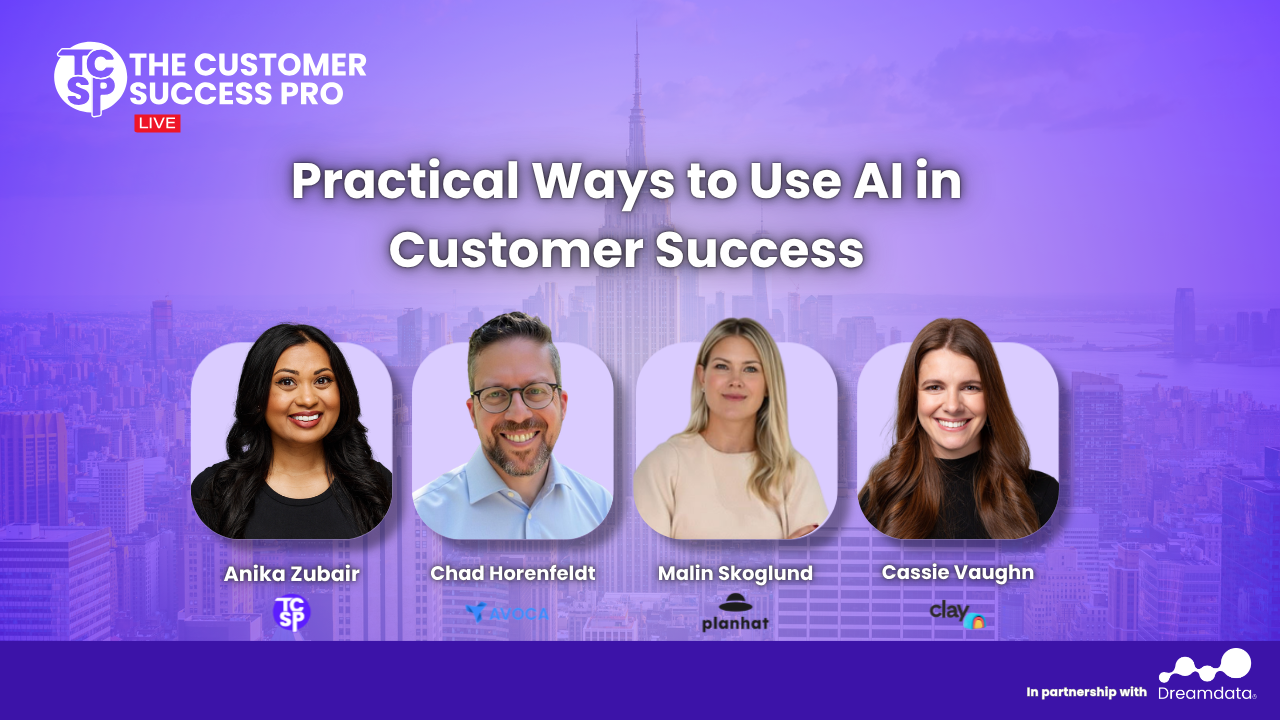
Jul 22, 2026AI in customer success is no longer a nice to have, it is something teams are implementing every single day. That was the clear theme at the first live recording of The Customer Success Pro Podcast, where the community came together in person in New York City for a panel on how AI fits into the modern customer success tech stack.
The panel brought together three leaders building at the edge of CS and AI: Cassie, Head of Growth Strategy at Clay, Maulen, who leads the CS team at Planhat, and Chad, who heads Customer Success at Voca. Each shared honest stories about what is working, what caused more work than it saved, and how they are helping their teams adopt AI without burning out. If you run a CS team and you feel behind, this conversation is a reminder that everyone is figuring it out in real time.
Build a Family of AI Agents, Not One Super Tool
One of the strongest ideas from the panel was Cassie's belief in building a family of agents rather than a single all knowing tool. Instead of one dashboard or one super agent that replaces customer success managers, she is building specialized agents that each handle a piece of the workflow and eventually feed a central chief of staff agent.
At Clay, that starts with a renewal ride along agent that prompts CSMs on the next step of the renewal, sends alerts, and handles the manual coordination with deal desk and legal. The team owns renewals and expansion, so freeing CSMs from administrative work gives them time back for pipeline generation and real customer conversations.
Maulen shared a similar story from Planhat, where an agent manages the sales to CS handover by summarizing every sales call, creating a handover document, suggesting an implementation manager, and even generating a kickoff deck. Chad built a coaching tool at Voca that reviews each team member's calls and calendar, shows them where they spend their time, and gives targeted feedback with links to the exact moment in a call. As he put it, he essentially outsourced his coaching while his team keeps growing fast.
The lesson is that you do not need one perfect agent doing everything. Small, focused agents compound into something powerful.
Clean Data Is the Foundation of AI in Customer Success
Every panelist agreed on one point: AI without context is trash. Customer success is famous for messy data, missing renewal dates, scattered contracts, incomplete handover notes, and AI only amplifies whatever you feed it.
Maulen preaches good data hygiene with customers every day and said Planhat will disqualify prospects whose data is too messy to support AI. Planhat even uses AI to clean data, reading PDFs to find contract start dates and renewal values, then updating the fields automatically. Cassie credited Clay's ops team with a heavy, partly manual audit to build a single source of truth across Salesforce, Snowflake, and other systems, calling it a one time foundation that now lets every downstream system run better.
Chad was refreshingly honest that Voca is still in the trenches on this, pulling data out, spotting outliers, and fixing issues as they surface. His advice: do not just trust how data sits in your CRM, pull it out, position it the way you manage your business, and inspect it constantly. Clean data is not glamorous, but it is what makes every agent and dashboard trustworthy.
Start With a Crawl: Small AI Wins That Save Hours
For anyone starting with no budget and no data team, the panel's advice was consistent: crawl before you walk. Maulen recommended picking one small step in a process you already run. At Planhat, the first win was automating the weekly enterprise implementation update email, pulling from transcripts, tickets, and emails so managers only review and send. That alone saved a few hours every Friday.
Chad added that experimentation should always start with an objective, a real problem you are trying to solve, rather than watching endless videos. He warned about pushing AI slop into Slack after an internal misfire, a reminder to keep a human in the loop. Cassie's starting point was centralizing as much context as possible, connecting Gong, Slack, Salesforce, and product feedback so any tool you build produces a richer result.
The through line is simple: start with something small, prove the time savings, then build the next thing.
Key Takeaways
Build a family of specialized agents instead of chasing one perfect super tool. Protect your data quality, because AI without clean context produces unreliable results. Start with a crawl, automate one small workflow, and let wins compound. Keep humans in the loop for value narratives, relationships, and strategic questions that AI cannot replace. And remember that at fast growing companies, AI is fueling more hiring, not less, because customers still buy from humans they trust.
Author