Customer Support Drives 30% of Help Scout's New Revenue
Jul 01, 2026Most revenue leaders come up through sales. Andrea Kale took a different route. She built her career in marketing, serving as a CMO for brands like BMW and MasterCard before stepping into a full revenue remit. Today she is Chief Revenue Officer at Help Scout, where marketing, sales, partnerships, and the customer team all report to her. That background gives her a clear view of something many revenue leaders miss, which is how the post-sales side actually drives growth.
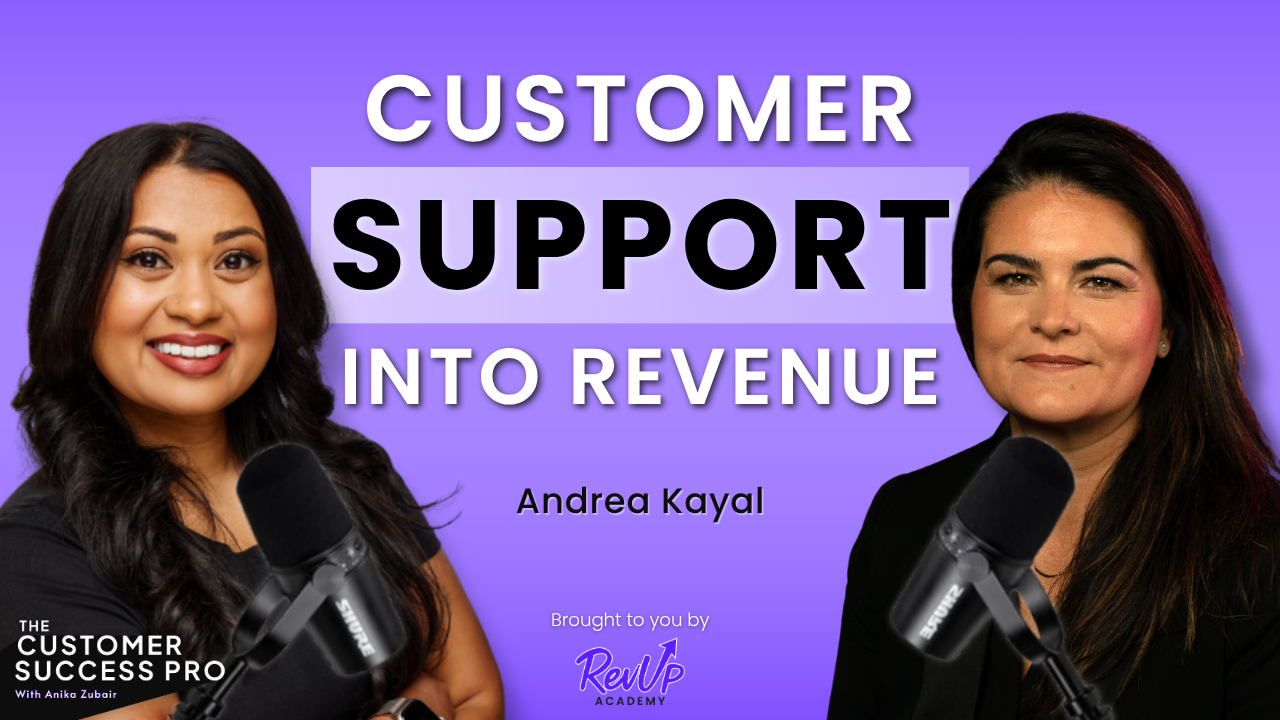
In this episode of The Customer Success Pro Podcast, host Anika Zubert sits down with Andrea to dig into a resegmentation Help Scout recently pulled off, why she believes churn is a product problem, and how a customer team of around 12 people keeps roughly 12,000 customers happy (and generates revenue while doing it).
Why Retention Belongs to the Product Team
Andrea offered a view she admits is controversial: the accountability for churn and retention should sit with the product team. Her reasoning is simple. No human, not even the best CSM or account manager, can save a customer who is not finding value in the product itself.
She points to Help Scout as proof. Customers can get up and running in 15 minutes and become power users within a day, so the support queue never fills with confused or frustrated people. Because the product works, the questions that reach a human are the ones that genuinely need one.
She framed it through Help Scout's ARPA model (accountable, responsible, participant, advisor). The customer team can be responsible for and participate in improving retention, but the chief product officer is the one who has to answer for whether customers vote with their dollars. Her advice to anyone interviewing for a commercial role: ask the company for its gross retention rate first, because gross retention shows exactly how many dollars are walking out the door each year, without being masked by new sales into the base.
How a Small Team Serves 12,000 Customers
With only about 12 people on the customer team, Help Scout cannot serve every account the same way. So Andrea led a resegmentation built on tiers and overlays.
The starting point was a single variable: annual recurring revenue. Andrea recommends ARR as the natural first split, because the goal is a support model that matches the level of care to what the business can economically sustain. Help Scout landed on four tiers.
The interesting part is what sits on top of those tiers. The team added two overlays. The first is white space, meaning expansion opportunities where customers are not yet using products like AI Answers, which is billed by consumption. The second is product adoption, flagging accounts that look unhealthy because they are not using features like workflows and therefore are not getting full value from the platform.
To build all of this, the team used Claude connected to their data through a tool called Hex, which links product usage, Salesforce, and HubSpot data in one place. Andrea would prompt it to show natural splits in the customer base and the white space available for a specific product, then ask how to staff against each tier. Her guidance for anyone trying this: get your data connected first, decide which variable defines your tiers, then prompt your way toward the opportunities hiding in your base, especially the revenue that tends to sit unexamined in the middle.
Human Support as a Revenue Engine
Here is the number that should make every support leader pay attention. Around 30% of Help Scout's new revenue comes from referrals, and Andrea traces that directly back to the quality of human support. Customers tell the company they were referred by a friend or colleague, and the reason is a support team that is thorough, kind, funny, and technical when it needs to be.
That does not mean Help Scout avoids AI. Basic questions, like a password reset or a simple how-to, are answered by AI Answers right inside the chat window. What matters is the design principle Andrea calls "no dead ends." If the AI cannot resolve a question, the customer is immediately offered a human. The AI handles the simple work so people can focus on the complex, account-specific problems where they do their best work.
Andrea compares AI to Excel. When Excel arrived, it did not replace accountants, it made every accountant faster. She sees AI the same way, as an accelerator rather than a replacement. She also pointed to an emerging idea, the forward deployed engineer, and what it could mean for CS. Because building is now far faster, CSMs can start thinking like product partners, delivering fixes and value to customers more immediately than the old roadmap-and-wait cycle ever allowed.
Key Takeaways
- Put accountability for churn on the product team, because no amount of human effort saves a customer who is not getting value from the product.
- Ask for a company's gross retention rate before you join, since it reveals how many dollars are actually leaving each year.
- Segment by ARR first, then layer on overlays for white space (expansion) and product adoption (health).
- Use AI tools to run the heavy analysis of your customer base, especially the revenue hiding in your middle tier.
- Let AI handle basic, repeatable questions so your team can deliver exceptional human support on the complex ones.
- Build "no dead ends" into your support so customers can always reach a human when the AI falls short.
- Treat AI as a co-pilot that frees CSMs to do strategic, revenue-driving work and act more like product partners.
🎧 Listen on your favorite platform:
🔹 YouTube
🔹 Spotify
Author