Building Customer Relationships – The Power of Multi-Threaded Engagements
May 20, 2026If your accounts feel secure because you have a strong champion, this episode will challenge that assumption.
In today’s B2B landscape, relying on one or two contacts is no longer enough. Buying committees are larger, budgets are tighter, and internal priorities shift faster than ever. What used to work five years ago simply does not protect revenue today.
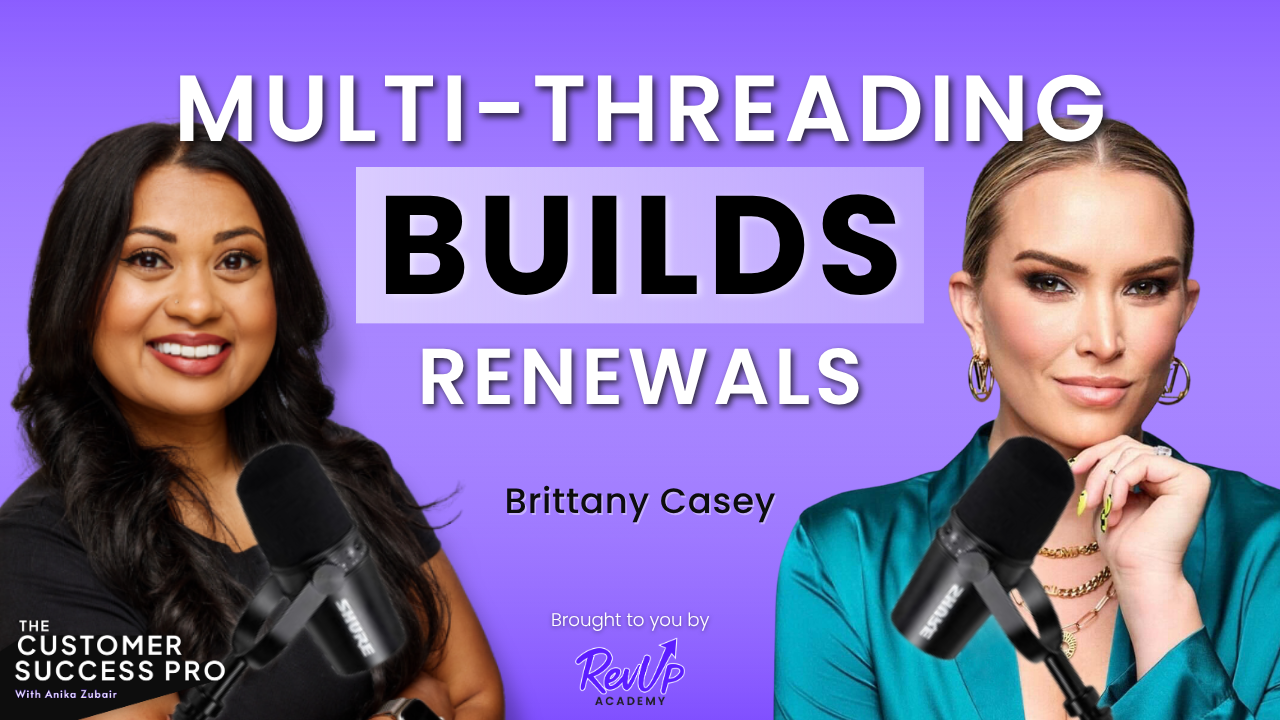
In this episode of The Customer Success Pro Podcast, Anika Zubair sits down with Brittany Casey, VP of Customer Success at Disco, to break down one of the most critical skills in modern customer success: multi threading.
This conversation goes beyond theory. It dives into how to actually build influence across an account, reduce risk, and create long term, revenue generating relationships.
Why Multi Threading Is No Longer Optional
Multi threading is not just about having multiple contacts. It is about having meaningful influence across different levels of an organization.
As Brittany explains, if you only understand one perspective inside an account, you are missing the full picture. End users, managers, and executives all have different goals. If you are not aligned with each layer, you are putting your renewal at risk.
There are two major reasons why multi threading is critical:
First, you cannot truly understand your customer without multiple perspectives. The value your product delivers looks very different depending on who you ask. Without those insights, your value story will always fall short.
Second, turnover is inevitable. Champions leave. Roles change. Priorities shift. If your entire relationship is built on one person, you are introducing unnecessary risk into your accounts.
In short, multi threading is not a nice to have. It is a core revenue protection strategy.
How to Build a Strong Relationship Map
Many teams create stakeholder maps during QBRs, then never revisit them. That is where things break down.
A strong relationship map is not just a list of names and titles. It is a strategic tool that helps you drive value conversations across the entire account.
Brittany shares a practical approach to building effective relationship maps:
Start with alignment across sales and customer success. Sales often holds critical context about how the deal was won, who influenced the decision, and what success was promised. Without that partnership, your map will always be incomplete.
Next, go beyond basic contact details. Instead of just tracking roles, define what value means to each stakeholder. Brittany uses value pillars such as speed, cost, quality, control, and sustainability to anchor these conversations.
Then, identify internal connections. One of the most overlooked opportunities is leveraging relationships that already exist within your company. Your executives, sales team, or technical experts may already have access to key stakeholders.
Finally, treat your relationship map as part of your success plan. It should evolve alongside your customer’s business, not sit static in a slide deck.
Common Mistakes That Kill Multi Threading
Even experienced teams struggle to execute multi threading effectively. The issue is rarely knowledge. It is consistency.
One of the biggest mistakes is treating relationship mapping as a one time activity. Creating a map once and never updating it leads to outdated insights and missed opportunities. The most successful teams revisit their maps regularly and adjust their strategy as the account evolves.
Another common mistake is trying to do everything alone. Many CSMs feel ownership over the account to the point where they avoid pulling in other team members. In reality, the best results come from leveraging your full account team.
Brittany describes the CSM as the quiet quarterback. You are not doing every task yourself, but you are orchestrating the strategy. You decide who engages, when, and how, based on what the customer needs.
A third mistake is failing to define next steps for each stakeholder. If there is no clear plan to deepen or expand a relationship, it will stagnate. Every contact in your map should have a defined action tied to growth or value.
Finally, many teams struggle to break into higher levels of the organization. The key here is partnership. Instead of pushing from the outside, identify internal champions who can advocate for you. Equip them with the right messaging, data, and outcomes so they can sell internally on your behalf.
Key Takeaways
Multi threading is one of the most powerful levers in customer success today, but only if it is executed with intention.
Here are the biggest takeaways from this episode:
- Multi threading is about influence, not just contacts. Having multiple names means nothing if you cannot drive value across those relationships.
- Sales and CS alignment is essential. The strongest account strategies come from collaboration, not silos.
- Value must be tailored to each stakeholder. A one size fits all message will not resonate across different levels of the organization.
- Relationship maps should be living documents. Revisit them regularly and adapt as your customer evolves.
- Your role is to lead strategically. Think like the quarterback, not just the executor.
- Leverage your customer as a partner. The best way to expand influence is by empowering champions to advocate internally.
At the end of the day, customers do not renew because of features. They renew because of trust, partnership, and proven value.
🎧 Listen on your favorite platform:
👉 YouTube
👉 Spotify
Author