AI Fluency in Customer Success: How to Help Your Team Actually Adopt AI
Jun 10, 2026Most customer success teams know AI matters. Leadership is asking about it, and a few people are experimenting with ChatGPT or Claude on their own. But there is often no real strategy behind any of it, and the day-to-day work keeps swallowing teams whole.
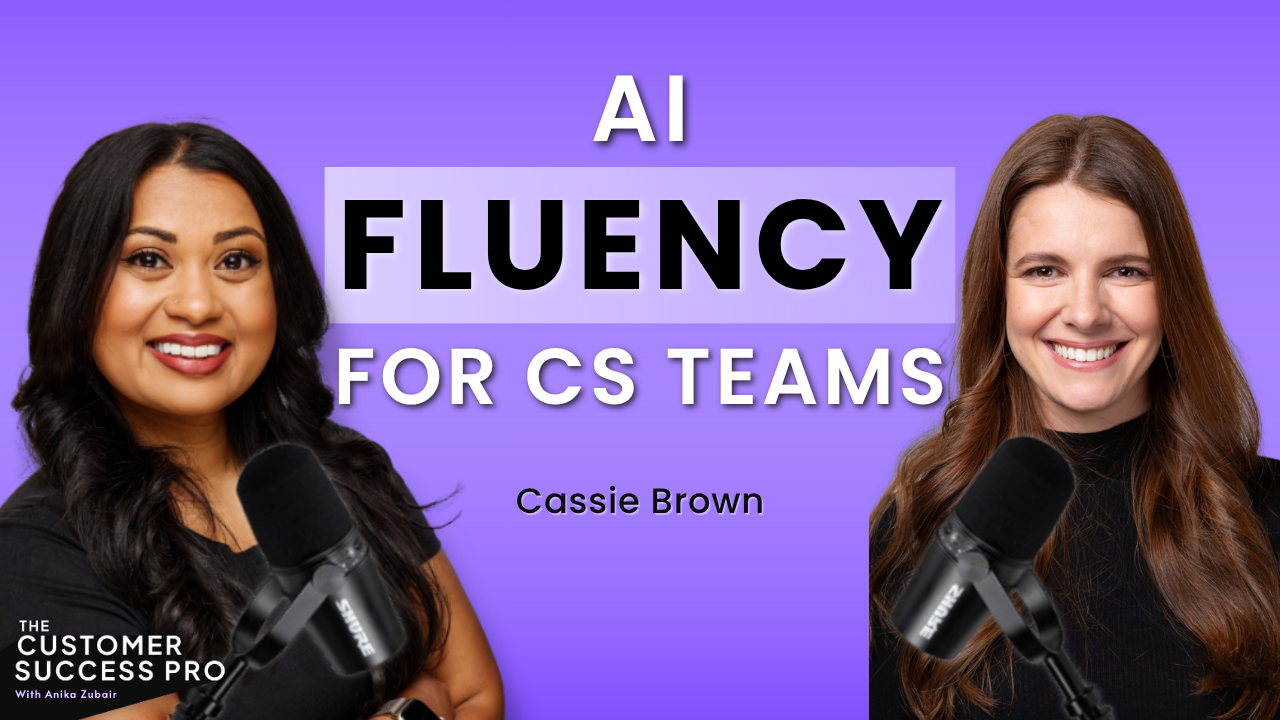
In this episode, host Anika Zuber sits down with Cassie Vaughn, who spent six years at Monday.com growing from enterprise CSM to Regional VP of Customer Success across North America and Latin America, with earlier stops at LinkedIn and Apple. Cassie is now Head of Growth Strategy at Clay, one of the fastest growing go-to-market platforms around. The conversation goes past whether your team uses AI and into how they adopt it in a way that drives real results.
Customer Success Is a Revenue Function, Not a Support Function
At Clay, the customer success team is called growth strategy, and they own the customer journey end to end. That means everything post sales, from onboarding through adoption, renewal, and expansion. They drive the commercial deal themselves rather than teeing up an expansion and handing it to an account executive.
Cassie sees this as where the discipline is heading. As consumption becomes a leading pricing model, value becomes expansion. The more a CSM drives adoption and proves value, the more natural the growth that follows. She also reframes the overused idea of the trusted advisor. Nobody has all the answers right now, so the more honest role is thought partner: someone navigating the unknown alongside the customer, sharing what they are learning, and creating a safe space to experiment together.
What AI Fluency Actually Looks Like
When Cassie led CS at Monday, she started building an AI fluency program with three parts. The first is self-education: knowing good sources, voices, and podcasts to follow, and understanding basic terminology like the difference between an LLM and an agent. She challenged herself to listen to two AI podcasts a day, once on each commute, for three months, and it made her noticeably more confident talking about the topic.
The second part is communication: taking what you learn, forming a point of view, contributing to conversations, and finding your voice in the space. The third is building: getting hands on with the tools, experimenting, and creating agents. Cassie is blunt that people both overestimate and underestimate prompting. As one Clay growth strategist put it, artificial intelligence is artificial, so you have to give it real human intelligence and structure for it to work well.
One useful update from Cassie: she no longer treats these as a strict sequence. Self-education, communication, and building can all happen at once, and running them together actually accelerates fluency. Think of it as an a la carte menu rather than a pyramid, where each person chooses where to start.
Build a Family of Agents, Not One Super Agent
A big mindset correction Cassie offers is to stop trying to build a single super agent that does everything. At Monday, Kim Landau created a family of agents for the scaled motion: a discovery agent that gathers requirements and synthesizes customer pain, a build agent that configures the product, and an optimization agent that refines the setup over time. Together they roll up into something close to a digital CSM.
Cassie is now sketching a similar idea for hiring at Clay: one agent that joins interviews and prompts her to dig deeper on certain questions, and another that drafts a scorecard she can edit. The human stays in the loop, because she does not want agents scoring or interviewing candidates. The agents handle structure and consistency so the team stays aligned without heavy lifting.
Two things make this work. First, psychological safety. Leaders should celebrate the people leaning into the discomfort, treat small failures as normal, and even laugh at the occasional agent that goes rogue. Second, creativity. Cassie argues the real limiting factor in AI is human imagination, not the tools, so go touch grass, stretch that creative muscle, and carve out budget so people can expense small AI subscriptions and tokens to experiment freely.
Key Takeaways
- Treat customer success as a revenue function that owns the journey end to end. Value drives consumption, and consumption drives revenue.
- Reframe trusted advisor as thought partner. You do not need every answer, you need to navigate the unknown with the customer.
- Build AI fluency across three fronts at once: self-educate, communicate a point of view, and build with the tools.
- Prompting matters more than people think. AI is only as good as the human intelligence and structure you give it.
- Skip the super agent. A family of small, specialized agents with a human in the loop beats one tool trying to do everything.
- Protect space to experiment, normalize small failures, and feed creativity, because imagination is the real constraint.
🎧 Listen on your favorite platform:
🔹 YouTube
🔹 Spotify
Author