Turning Renewals into Predictable Revenue Forecasts and an Upsell Pipeline
Jan 28, 2026Intro
Renewals should not feel like a last minute scramble, but for many Customer Success teams, they still do. One quarter you are confident, the next you are firefighting, chasing stakeholders, and hoping the renewal lands because the relationship feels good.
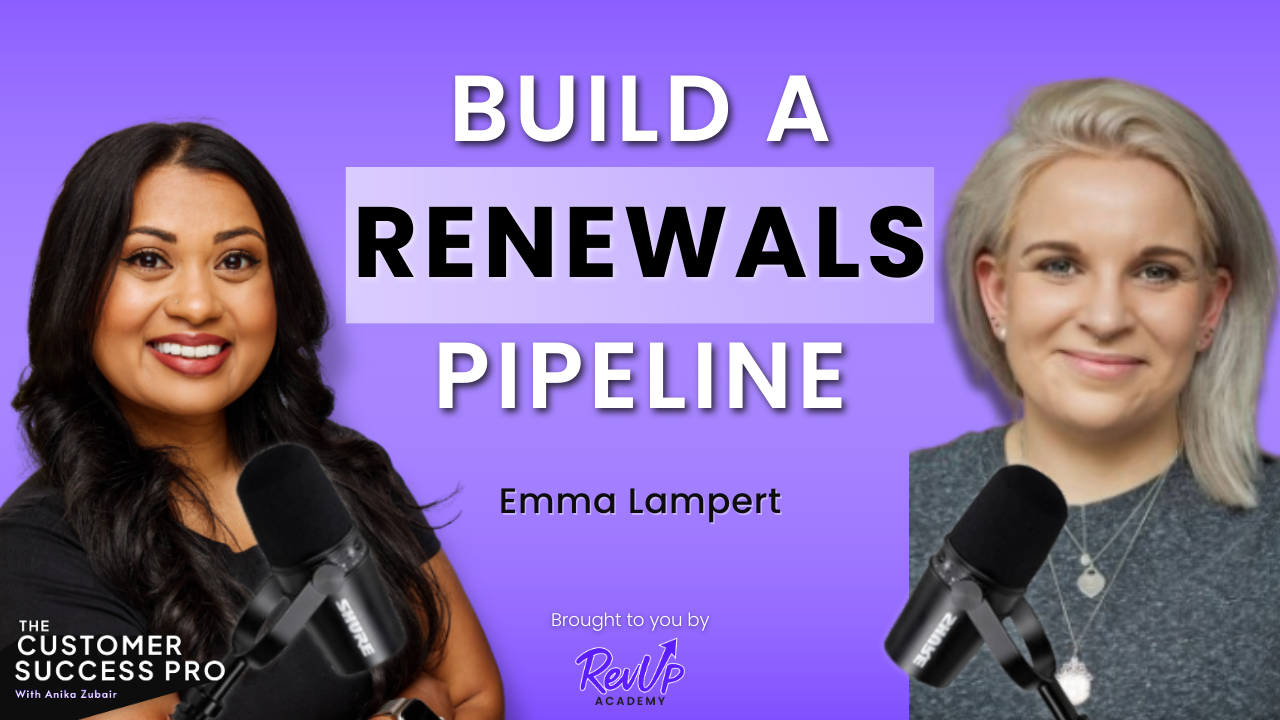
In this episode of The Customer Success Pro Podcast, Anika Zubair sits down with Emma Lampert, VP of Customer Success at Ably, to unpack what actually makes renewals predictable. Not vibe, not hope, not a “strong relationship”, but a system.
Emma brings 15 years of experience building commercial Customer Success teams across startup and scale up environments. She leads Customer Success, Support, and Customer Operations at Ably, where the team owns onboarding, adoption, renewals, and expansion. In other words, they sit at the intersection of technical depth and commercial ownership.
If you want renewals to stop feeling like guesswork and start behaving like a revenue engine, this conversation gives you the mechanics to make that shift.
Why renewals are a commercial motion, even if you hate that word
A big theme in this episode is the thing many teams avoid saying out loud.
Customer Success IS commercial.
Emma frames it clearly, a renewal is a lagging outcome of value delivered throughout the year. If the customer has achieved outcomes, the renewal is easier and often larger. If value is unclear, the renewal becomes flat, discounted, or at risk.
Anika reinforces the same point, a contract is not a guarantee. Even in subscription SaaS, the customer has every right to cancel, downgrade, or reduce scope. The renewal is simply the next sale, and the size of that sale is shaped by how well you connected the product to outcomes.
This is where many CS professionals get stuck. They mentally separate themselves from “sales” and treat renewals as an admin task. But when you detach from revenue, you also detach from business leadership. Emma’s take is simple, if you do not understand how the work you do ties to how your business makes money, you are missing a core leadership skill.
Her advice for CS leaders who want to step into revenue ownership is to build financial literacy. Learn how to read a P and L, understand cost to serve, and recognize the downstream impact of decisions like credits, discounts, and pricing changes. When you understand those levers, you stop operating in a silo and start leading with commercial clarity.
The forecasting system that makes renewals predictable
Forecasting is where Emma gets very practical, and very specific.
Her team forecasts six months out. They cover the current quarter and the next quarter so leadership has a clear view of the next six months of revenue pattern. The reason for six months is runway. If you uncover risk at three months, you are likely already too late to meaningfully change the outcome, especially when customers book meetings slowly and priorities move on their timeline.
At the six month mark, Emma expects CSMs to have a direct conversation with their champion around a simple reality: have we delivered enough value for you to confidently renew for another year?
That question is uncomfortable for many CSMs, which is exactly why it matters.
Anika shares a direct question she used as a CSM: “If your renewal was due tomorrow, would you renew?” Emma admits she used to avoid these questions too, until she got blindsided by a churn decision, despite having a strong relationship. The lesson was painful but useful, you cannot forecast on vibes. You need to know where value is landing, who owns the product long term, and whether the business case holds.
To operationalize this, Emma runs a weekly forecast cadence. CSMs update their CRM forecast every week with expected renewal size, best case, worst case, and notes that explain what changed. The cadence matters because it creates a rhythm where renewals are treated like deals, not distant events.
She also uses a simple three question framework to assess account reality without turning customer health into a giant data collection exercise:
-
WHO CARES
Which stakeholders are engaged, who are champions or detractors, who signs contracts, and how well multithreaded are you?
-
HOW DEEP
How embedded is the product technically, are they surface level users or deeply integrated, are they using multiple products or use cases?
-
WHAT IS CHANGING
Can they define ROI, can they measure it, and what signals suggest momentum is improving or slipping?
These three questions do what most health scores fail to do. They force strategic clarity. They also make forecasting conversations sharper because the CSM is not guessing, they are reporting what they know.
Building an upsell pipeline that does not feel salesy
The other half of predictable revenue is expansion, and Emma’s view is refreshingly grounded.
Upsell does not start three weeks before renewal with a random “do you need more?” question. It starts with consistent discovery throughout the customer lifecycle.
If you are talking to customers about their roadmap, their pain, and what success looks like, you naturally uncover adjacency. Another team with the same problem. A new use case. A complementary product. A deeper rollout. Expansion becomes the next logical step in value, not a forced sales pitch.
One of Emma’s favorite coaching points is about discovery discipline. Most of us flip into solution mode too quickly. We hear a problem and immediately offer an answer. But if you do not let customers sit in the pain long enough, you never learn if it is urgent, meaningful, and worth prioritizing. That is where expansion opportunities get missed, or worse, you chase “nice to haves” that never close.
Anika adds an important layer here, discovery should happen in every interaction, not only during onboarding or a QBR. The quick 30 minute call, the lunch meeting, the implementation check in, all of it can uncover what is changing in the customer’s world. If you want upsells to feel natural, discovery needs to be continuous.
Because Ably is consumption based, Emma’s team ties expansion to adoption projects. Instead of obsessing over a specific uplift number on every account, they track a pipeline of initiatives that increase usage and deepen technical engagement. More adoption leads to more consumption, which leads to revenue growth and retention. The commercial result might land later, but the leading indicators are being built now.
The bigger takeaway is that renewal qualification and expansion discovery are not separate motions. They support each other. Customers pay attention at renewal because money is involved. That attention window is your moment to connect value to commercial clarity and align on what comes next.
Key takeaways
-
Customer Success is a commercial function, renewals are a sale and should be treated like one.
-
Forecast six months out so you have runway to change outcomes, three months is often too late.
-
Use direct renewal questions early, avoiding them does not prevent churn, it just hides it.
-
Build forecasting confidence with cadence, weekly updates create focus and momentum.
-
Simplify account risk with three questions, who cares, how deep, what is changing.
-
Upsells are a natural outcome of continuous discovery, not a last minute pitch.
-
Improve your commercial leadership by learning how your business makes money, read the P and L, understand cost to serve, and connect CS decisions to revenue outcomes.
🎧 Listen on your favorite platform:
👉 YouTube
👉 Spotify
Author