How to Prove ROI When Your Product Does Not with Natasha Evans
Feb 25, 2026How do you prove ROI when your product does not clearly show it for you?
That is the question so many Customer Success teams are wrestling with right now. You know your product works. Your customers are logging in. Adoption looks decent. Conversations feel positive. But when it comes time for a renewal or executive business review, you are suddenly asked to quantify impact.
And that is where confidence starts to wobble.
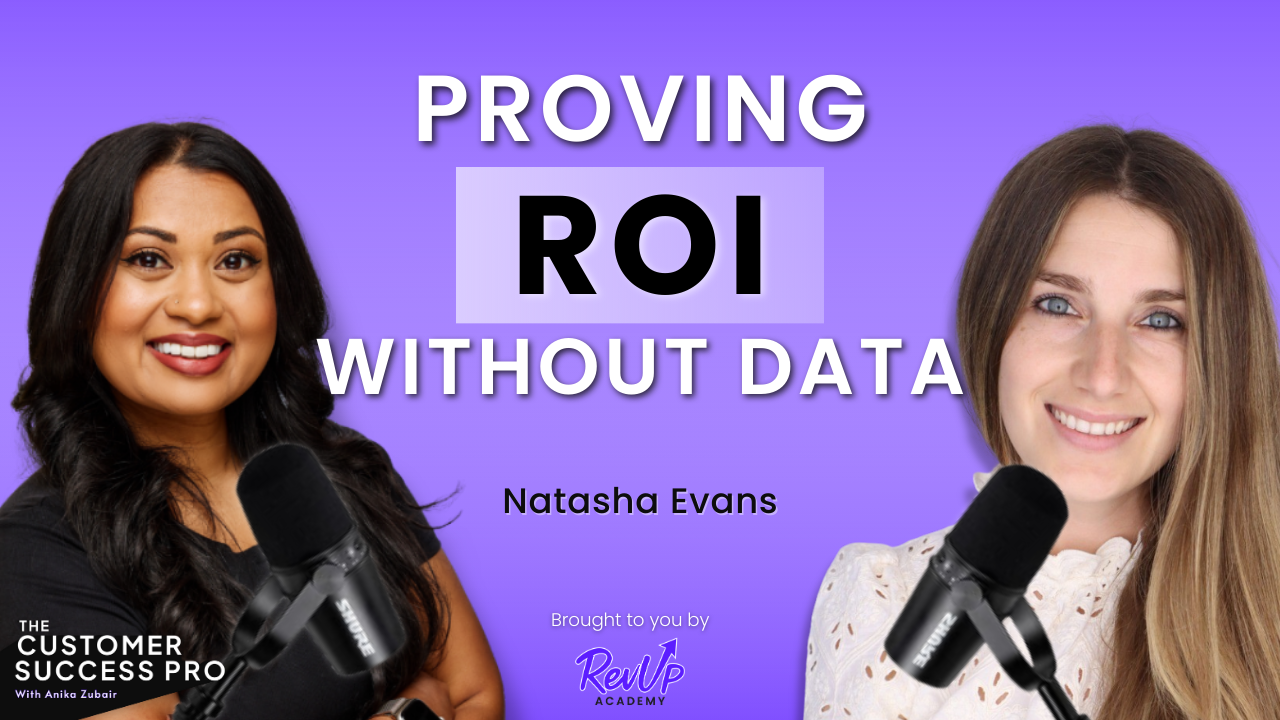
In this episode of the Customer Success Pro Podcast, I sat down with Natasha Evans, VP of Customer Growth at Hook, to unpack how CS teams can articulate value and prove ROI, even when dashboards fall short.
Natasha has led global Customer Success and renewals at Salesloft and built practical frameworks that help teams translate product usage into business impact. What followed was a masterclass in value storytelling, commercial confidence, and leading with outcomes.
Why ROI Conversations Start on Day One
If you are struggling to prove ROI at renewal, the issue usually did not start at renewal.
It started on day one.
Natasha emphasized that the very first customer conversation must set the tone for value. Before diving into features, onboarding steps, or login instructions, CSMs need to establish that they care about business outcomes.
That means asking:
-
What are the company’s top objectives this year?
-
What will make your champion look good internally?
-
What metrics matter to the executive team?
And importantly, explaining why you are asking.
Context builds trust. If customers understand that you are asking about business goals to help prove value later, they are far more likely to engage in that conversation.
One powerful tip Natasha shared is adjusting your questions based on your stakeholder. If your day to day user does not know high level company goals, ask:
-
What did your CEO focus on at the last all hands?
-
What were the big themes at your company kickoff?
This approach allows you to extract business context without making someone feel put on the spot.
Value conversations are not one off moments. They are set up from the very beginning.
When Your Product Does Not Show ROI
Let’s address the uncomfortable reality.
Most products do not have a built in ROI calculator that magically ties usage to revenue.
And that is okay.
ROI does not have to be perfect. It has to be credible.
At Salesloft, Natasha and her team built simple ROI narratives around time savings and efficiency. They identified a handful of measurable product activities, assigned conservative time estimates to them, and calculated total time saved.
The key word here is conservative.
Overstating ROI destroys credibility. But realistic, transparent assumptions create trust.
From there, time saved could be translated into:
-
Efficiency gains
-
Avoided headcount
-
Increased productivity
-
Potential revenue influence
You do not need calculus. You need logic, storytelling, and alignment.
And here is a powerful tactic: socialize your ROI estimate with your champion before presenting it to executives. Ask for feedback. Validate assumptions. Adjust if needed.
If they disagree with your numbers, that opens the door to a better conversation:
“Great, what would we need to measure to make this more accurate?”
Suddenly, you are collaborating on value measurement instead of defending it.
Marketing, Messaging, and the Identity Crisis in CS
One of the most fascinating parts of our conversation was Natasha’s dual role leading both post sale teams and marketing at Hook.
That vantage point highlights something critical.
Value articulation is not just a CS problem. It is a company wide messaging challenge.
In a world where every SaaS tool claims to use AI, differentiation matters more than ever. Natasha referenced positioning principles inspired by April Dunford, focusing on what your product uniquely does that no one else can.
Instead of shouting “We drive revenue” like everyone else, focus on:
• What only you can do
• The direct impact of that capability
• The business outcome that follows
This applies inside CS too.
If your narrative is vague, your renewal conversations will feel vague. If your positioning is clear and differentiated, your ROI story becomes sharper.
Customer Success today is at an identity crossroads. Are we support? Are we account managers? Are we revenue leaders?
Natasha’s view is clear. Commercial accountability matters. Renewals and upsells are not dirty words. CSMs already have many of the necessary skills. They simply need practice and enablement.
And leaders must step up.
Sales teams receive constant enablement. Why should post sale teams be any different?
If you want revenue driven CS, you must train for it.
Key Takeaways
Here are the biggest lessons from this episode:
1. ROI starts on day one. Set the expectation that you will measure and prove value from the beginning.
2. Always tie product usage to business objectives, not just adoption metrics.
3. If your product does not show ROI, build your own estimate using conservative assumptions.
4. Validate your value story with your champion before executive conversations.
5. Keep your value narrative simple. Two or three clear steps are more powerful than a complex framework.
6. CS leaders must enable their teams to think commercially. Do not wait for perfect tools. Start now.
Customer Success does not need perfect dashboards to prove impact.
It needs clarity, confidence, and the courage to ask better questions.
🎧 Listen on your favorite platform:
👉 YouTube
👉 Spotify
Author