From PLG to SLG: How to Rebuild Customer Success When You Go Upmarket
Feb 11, 2026If your company is moving upmarket, you can feel it before the org chart ever changes.
Suddenly, the customers coming in are bigger, more complex, and way less patient with “support style” engagement. They expect strategy, proactive guidance, and a clear value narrative that connects product usage to business outcomes. And if your Customer Success team is still operating like a high scale PLG machine, you get the most common symptom of all: your CS org starts lagging behind the revenue motion.
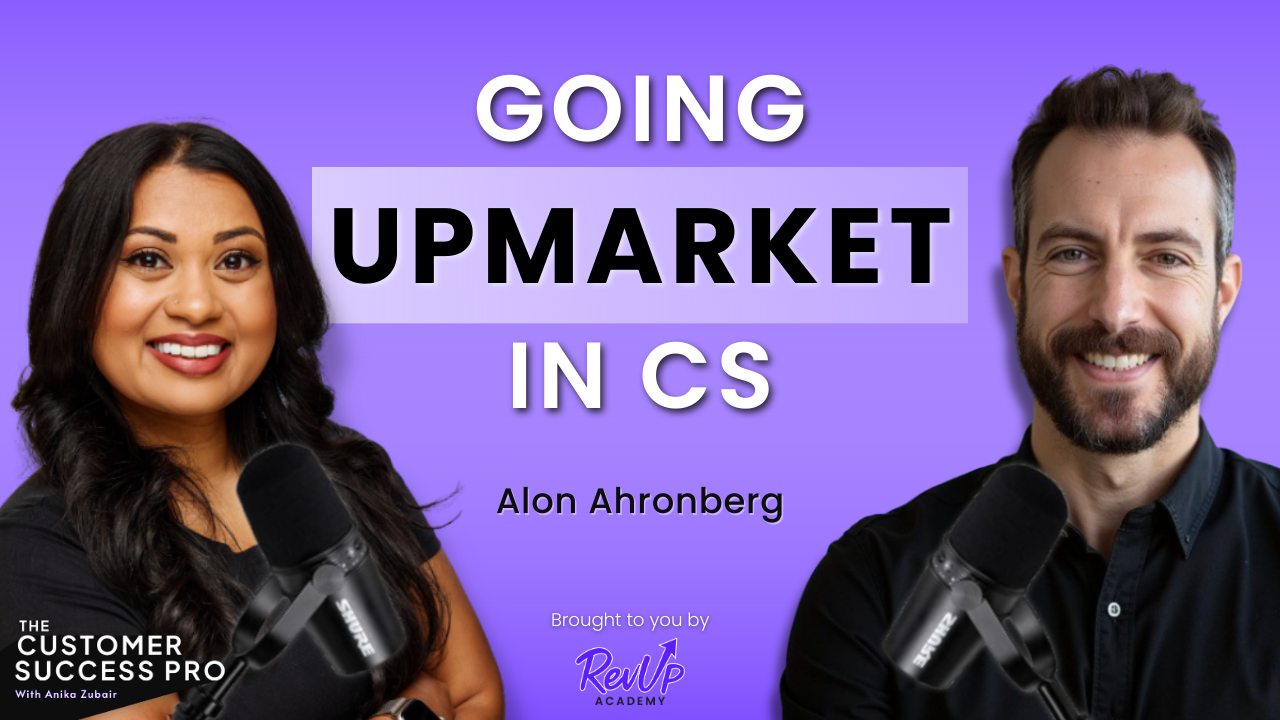
In this episode of The Customer Success Pro Podcast, I’m joined by Alon Ahronberg, VP of Customer Success at Atera, to unpack what it really takes to rebuild Customer Success when a SaaS company shifts from Product Led Growth to Sales Led Growth. We talk segmentation, redefining service levels, creating proactive journeys, re onboarding long time customers, and why AI is pushing CS to become what it was always meant to be: consultative, strategic, and industry fluent.
If you are a CS leader trying to scale upmarket, or a CSM feeling the ground shift under your role, this conversation is your playbook.
From PLG scale to SLG strategy, the org has to change first
One of the most important context points Alon shares is this: Atera already had tens of thousands of customers, an existing CS function, and a mature sales org. The shift was not “we are becoming sales led someday,” it was already happening. Nearly 40 percent of revenue was coming from sales, which meant bigger deals, higher touch expectations, and larger organizations entering the customer base.
But CS was still operating like a scaled PLG engine.
Alon described a model where CSMs were managing 500 to 1,000 accounts each. That might work when your motion is largely self serve and customer expectations are transactional. It breaks the moment you sell into more complex environments where onboarding, adoption, and executive level value conversations determine renewals.
So what did he do first?
He did not start with “let’s hire more CSMs.” He started with changing the shape of the book of business.
His approach was simple and practical:
-
Draw the line between no touch and managed accounts
-
Segment primarily by ARR as the fastest way to get a first pass
-
Start redefining the journey based on service tier expectations
-
Shift the org mindset from reactive to proactive, starting from day one
This is the key lesson: moving from PLG to SLG is not a headcount problem, it is an operating model problem. If you keep the same motions and just add more people, you scale the wrong behavior.
The foundational building blocks, health score, QBRs, dashboards, forecasting
When you inherit a large customer base, you cannot “flip a switch” and ask 20 CSMs to suddenly run perfect customer journeys. Alon was clear about sequencing. The goal was transformation, but the method was step by step.
Here are the building blocks he prioritized first:
HEALTH SCORING TO UNDERSTAND REALITY
Even if the early health score is imperfect, you need a shared language for “healthy,” “neutral,” and “at risk.” They started with a practical model that included CSM sentiment, then used it to map the book of business and identify where to focus.
STANDARDIZED QBR FORMATS
They built different QBR formats for bigger accounts versus medium touch accounts. This matters because QBRs are not a presentation, they are a system for collecting the right data, asking better questions, and aligning on value. When QBRs are standardized, they become an engine for insights, not just a calendar event.
DASHBOARDS AND KPIS FOR LEADERSHIP CONTROL
You cannot run proactive CS without visibility. Alon emphasized dashboards, KPIs, and metrics to track whether new processes were actually being implemented. In other words, they did not just design a new operating model, they measured adoption of the operating model internally.
FORECASTING TO MOVE FROM FIRE FIGHTING TO STRATEGY
They introduced forecasting mechanisms to understand renewal risk and expected outcomes across quarters. This is one of the biggest shifts when moving into SLG. The business expects CS to contribute to predictability, not just relationships.
If you want a quick takeaway here, it is this: proactive CS is built on clarity. Clarity on customer health, clarity on the engagement cadence, clarity on internal execution, and clarity on risk.
Adoption that drives renewals, plus re onboarding as a proactive retention play
A huge part of rebuilding CS is redefining what “adoption” actually means. Alon shared a realistic view: adoption is a never ending task, and most teams are not done. His team was about 60 percent of the way there, still improving, and actively exploring how AI can accelerate insight generation.
So how did they approach adoption in an enterprise motion?
They mapped their product pillars and identified the sticky features, the ones most tied to long term retention. Then they looked at:
-
Usage volume per account
-
License utilization
-
Feature set usage
-
Patterns across customers who had renewed for years
That allowed them to build a picture of what “healthy usage” looks like. Not just “logins,” but the combination of users, utilization, and feature depth that correlates with real value.
Then they layered in a crucial point: not every feature is relevant for every customer. Adoption has to be tied to customer goals and use cases, which means CSMs still need consultative conversations to interpret the data.
RE ONBOARDING: THE MOVE MOST TEAMS MISS
One of my favorite parts of this episode was Alon’s approach to re onboarding.
They redesigned onboarding with clear packages based on customer size and complexity, including goals, checklists, and defined success criteria. Then they realized something important: many existing enterprise and strategic accounts had never gone through a structured onboarding process.
Instead of waiting for complaints, they treated it as a future risk and launched a proactive re onboarding initiative.
Operationally, they did two smart things:
-
They identified the “strategic accounts” population that missed proper onboarding
-
They created a task force, pulling in support from other departments like pre sales and tier two engineers, nicknamed the Delta Force
Re onboarding was positioned as a value add offer, not an apology tour. The outreach focused on “what’s in it for you,” like underutilized areas of the product, free training sessions, and targeted help to implement key capabilities.
The lesson: if you are moving upmarket, your legacy customers are either a retention asset or a churn liability. Re onboarding turns them into an asset.
Key takeaways
-
Moving from PLG to SLG requires a new operating model, not just more headcount
-
Start with segmentation, define managed versus no touch accounts, then redesign the journey
-
Health scoring and QBR standardization create a shared system for proactive CS
-
Dashboards, KPIs, and forecasting shift CS from reactive support to strategic revenue influence
-
Adoption should be tied to product pillars and sticky features, but always grounded in customer goals
-
Re onboarding is one of the highest leverage retention plays for long time customers who missed structured onboarding
-
AI is reducing friction work, but it also raises the bar, the CSM of the future is a consultant, not a report reader
🎧 Listen on your favorite platform:
👉 YouTube
👉 Spotify
Author