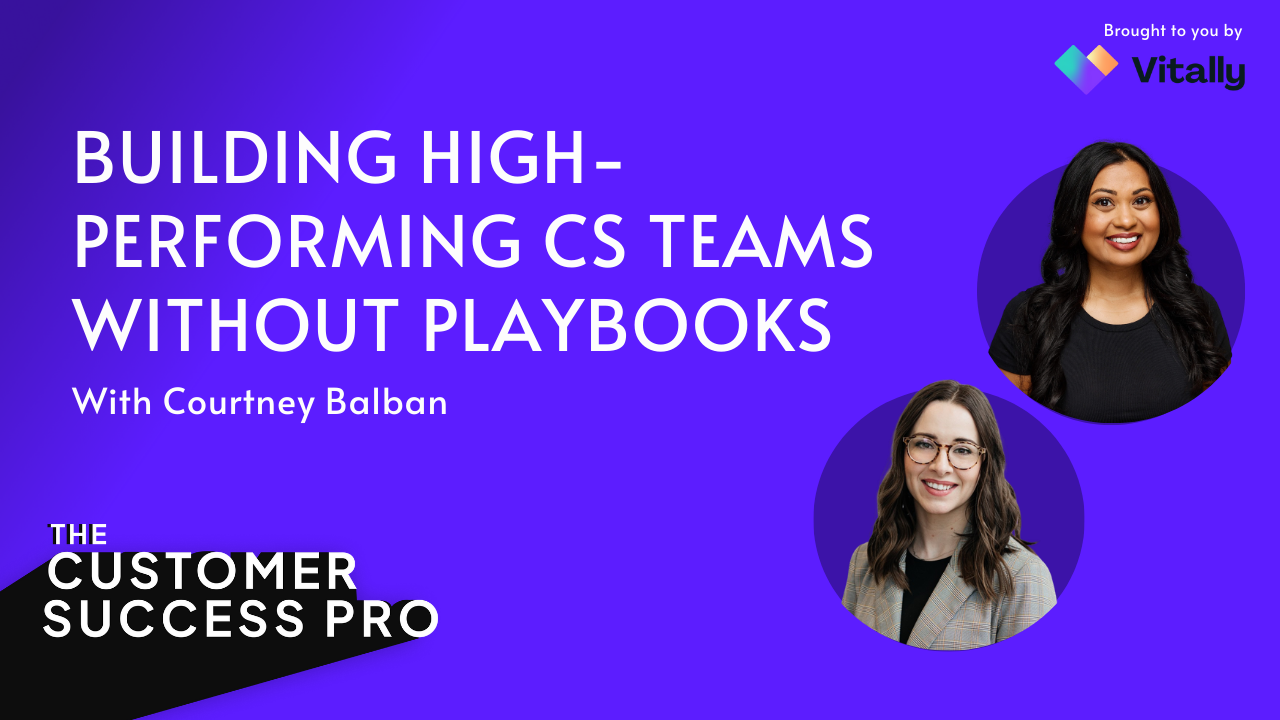
Building High-Performing CS Teams Without Playbooks with Courtney Balban
Dec 03, 2025Want to win a free pair of airpod pros, sign up for a demo with Vitally: https://www.vitally.io/cspro
The Objection Handling Guidebook for CS:
https://www.thecustomersuccesspro.com/offers/Z6Ng26vg/checkout
Customer success is louder than ever. New tools, new requests, new internal priorities, new fire drills. Most CS teams are drowning in alerts and activity, then still lying awake at night wondering, did I actually move the needle for my customers today.
In this episode of The Customer Success Pro Podcast, Anika sits down with Courtney Balban, VP of Customer Success at Leadr, a manager enablement platform that helps organizations develop better managers and higher performing teams. Courtney brings a rare blend to CS leadership, ten years as a therapist and coach before she ever touched SaaS, plus the lived experience of growing from CSM to VP while owning the full post sales journey.
Together, they unpack how curiosity, psychological safety, and a focus on outcomes over activity can transform the way CS teams operate, show up for customers, and position themselves as genuine growth engines for the business.
Curiosity as a CS superpower
Courtney describes her career shift from therapist to customer success as using the same muscle in a different setting. Therapy is about understanding why people behave the way they do, what helps them thrive, and how systems shape their outcomes. Customer success, at its best, is not that different.
As a CSM, she realized that her real job was not to simply answer customer requests. It was to:
• Guide customers toward what they actually need, not only what they ask for
• Spot patterns across accounts, not just put out one off fires
• Stay curious long enough to reach the real problem before offering a solution
That curiosity became a superpower as she moved into leadership. Instead of treating every escalation as a fire to put out, she started to ask wider and deeper questions. What is really going on here. Is this a symptom or a root cause. Is this request tied to an outcome that matters for the customer and for the business.
Most CSMs want certainty. They want the script, the playbook, the exact slide template for every business review, because structure feels safe. Courtney saw the downside of that comfort. When the team over relied on scripts, they became robotic and reactive. They followed the checklist, but they could not always think critically in the moment.
Her answer was not to burn the playbooks. It was to delay them. First build the judgment muscle, then layer in structure to support good thinking. Playbooks should enable curiosity, not replace it.
From activity to impact: cutting through the noise
One of the biggest themes in the conversation is the difference between activity and impact.
Most CS teams are incredibly busy. Slack is buzzing. Product wants more feedback. Sales wants a quick favor. Customers are sending feature requests, training ideas, and one off bugs. Everything feels urgent. Very little actually moves retention, expansion, or meaningful customer value.
Courtney coaches her team to pause and interrogate the work in front of them. Two core questions sit at the center of how they cut through the noise:
• Does this solve a root problem or only treat a symptom
• Does this meaningfully move retention, expansion, or customer outcomes
You can still decide to tackle a one off symptom, but you name it for what it is. Over time, you start to see patterns in what keeps showing up. That is where you invest time and process, not in chasing every request at the same level of urgency.
She shares a practical example from one of their top ten customers. The customer wanted a specific performance review feature that Leader did not have. Instead of saying, I will pass that to product, the CSM went deeper. Why do you want to run reviews that way. What insight does that give you. How do you use that information as an HR team.
With a few extra questions, they discovered the business outcome the customer really needed, then realized they could solve eighty percent of it with existing functionality and justify building the remaining twenty percent. The customer felt heard, adoption grew, and the account expanded. All because the CSM did not stop one question too early.
That is the pattern Courtney wants every CSM to follow. One more question. One more layer of why. One more step past the surface request.
Building full cycle teams and psychological safety
At Leadr, CSMs are truly full cycle. They own implementation, adoption, ongoing value, renewal, and expansion. They are the hub of the wheel for everything that happens after the contract is signed. That model keeps the journey simple for customers, but it is demanding on the team.
To make that model work, Courtney focuses on two big levers.
First, psychological safety.
The team used to be afraid to fail. They wanted perfect answers, perfect decks, and perfect scripts. Courtney and the leadership team had to normalize discomfort. That meant:
• Leaders saying I do not know the answer, let us figure it out together
• Playing call clips where they themselves did not nail it, and asking the team for feedback
• Making coaching sessions about growth, not catching people doing something wrong
Once CSMs felt safe to try, they were willing to experiment with deeper discovery, harder questions, and more strategic conversations.
Second, clarity and capacity, especially for middle managers.
Managing managers is its own skill. Courtney talks about living in the tension between being a teddy bear and a bulldozer. Leaders need to feel supported and seen as humans, but they also need clear direction and strong guardrails. Her job is to remove noise where she can, fight for their capacity, and reinforce what really matters so their teams are not stretched across every possible request.
As curiosity and safety grew, something else shifted. Internally and externally, CSMs started to be seen as trusted advisors instead of the catch all team. They stopped being pure retention insurance and started to be recognized as a growth engine. That boosted morale, reduced turnover, and made the work more energizing, because the team could see the direct impact of their thinking on customer outcomes and company strategy.
Key takeaways
If you are a CSM or CS leader trying to navigate the noise, here are the biggest lessons from Anika and Courtney’s conversation.
• Curiosity is not a nice to have, it is a core skill
One more thoughtful question can unlock the real problem, the real value story, and the real expansion path.
• Scripts and playbooks come second, not first
Build judgment, discovery, and critical thinking first. Then use playbooks to support those skills, not to replace them.
• Measure impact, not just activity
A full calendar does not mean you are effective. Anchor your work in retention, expansion, and meaningful customer outcomes.
• Psychological safety unlocks strategic behavior
Your team cannot ask bold questions if they are terrified of making a mistake. Model vulnerability, share your own misses, and coach in public.
• Be louder about the right things
CS holds the closest insight into what really works for customers. When you speak clearly about outcomes, not just tickets and feature requests, you shape product, positioning, and company strategy.
Customer success is under more pressure than ever, but that does not mean you have to live in constant reaction mode. With curiosity, clearer choices about impact, and a culture where it is safe to learn out loud, your team can step into the role it deserves to play, as a true revenue partner and transformation engine for your customers.
🎧 Listen on your favorite platform:
👉 YouTube
👉 Spotify
Want to take your CS career to the next level:
✅ RevUP Academy: https://www.thecustomersuccesspro.com/revup
✅ AI Guidebook for CS: https://www.thecustomersuccesspro.com/resources
Author